
Proceedings Cannot Be Quashed Merely On The Ground That No Individual Employee Is Identified: Supreme Court Lays Down Principles To Attribute Mens Rea To Companies
Saima Anjum
The Supreme Court has held that criminal proceedings against a company accused of an offence cannot be quashed merely on the ground that no individual director, officer, or employee has been identified or arraigned as a co-accused, even where the offence charged requires proof of mens rea.
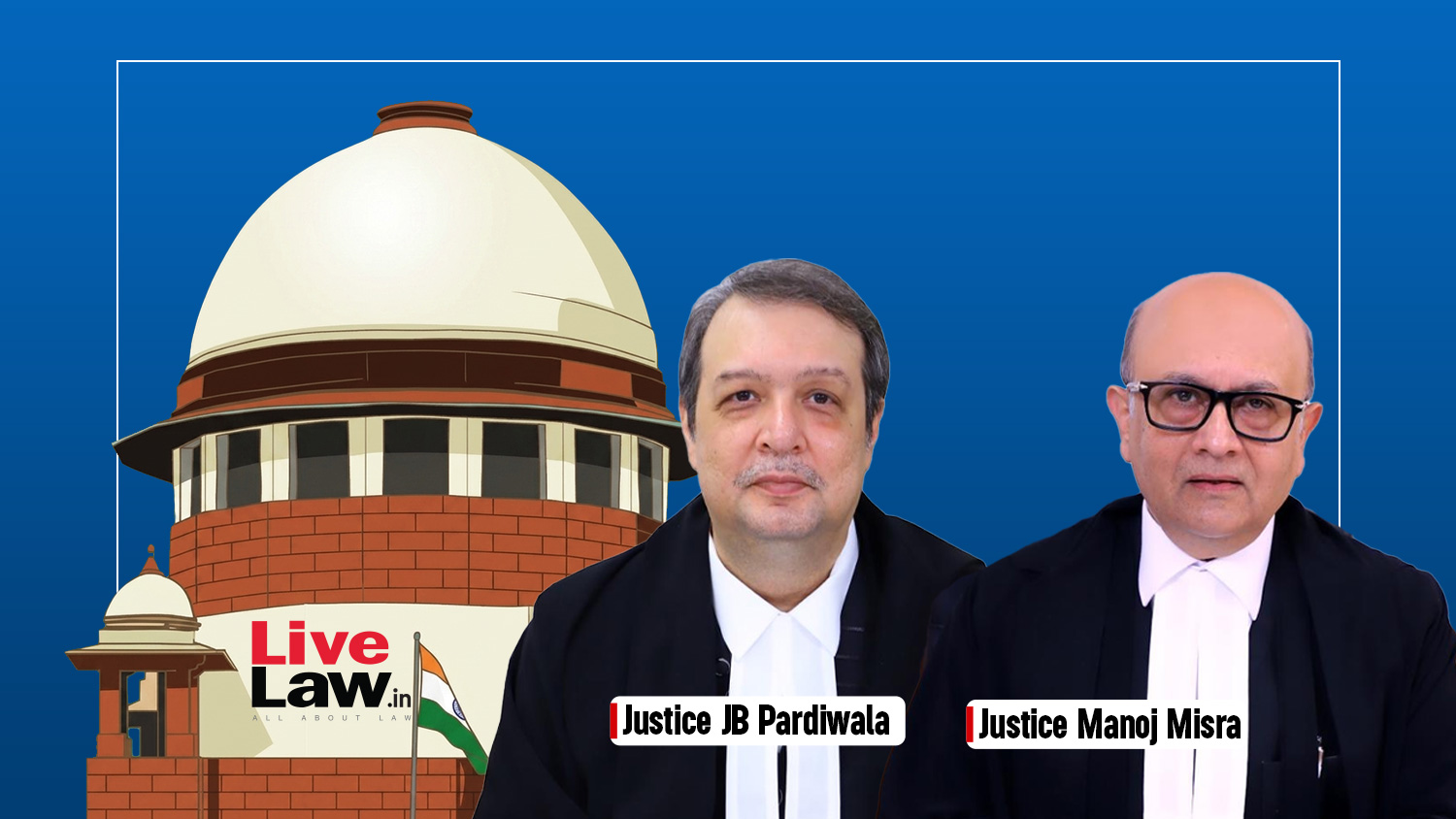
A bench of Justice JB Pardiwala and Justice Manoj Misra held so while hearing an appeal filed by a pharmaceutical company, against a Karnataka High Court order that had refused to quash a corruption and criminal conspiracy case arising out of alleged irregularities in drug procuration by the Bhabha Atomic Research Centre (BARC).
Dismissing the appeal, the bench perused English and Indian law on corporate criminal liability and evolved a fresh, three-stage framework for determining when the guilty mind of a natural person can be attributed to a company.
The appellant (pharmaceutical company) had supplied medicines to a BARC project. It was arraigned as accused no 4 (A4) in an FIR registered by the Central Bureau of Investigation (CBI), wherein it was alleged that one Dr Anand (Scientific Officer, BARC) had conspired with several pharmaceutical companies to procure medicines at inflated rates and in excess quantities.
A chargesheet was subsequently filed in 2017 against Dr Anand (accused 1/A1) and the pharmaceutical company (accused 2/A2/appellant) under Section 120B read with Section 420 of the Indian Penal Code, 1860 (IPC, now Section 61 and Section 318 of the Bharatiya Nyaya Sanhita, 2023 respectively). Sections 11, 12, 13(2) read with 13(1)(b), and 13(1)(d) of the Prevention of Corruption Act, 1988 (PC Act) were also invoked. However, no employee or official of the pharmaceutical company (appellant) was named as an accused.
The pharmaceutical company approached the Karnataka High Court seeking to quash the proceedings, contending that a company cannot be prosecuted for criminal conspiracy independently of the natural persons who acted on its behalf, and since no employee of the company had been arraigned as an accused, the prosecution against it could not be sustained. The High Court, relying on the Supreme Court’s ruling in Iridium India Telecom Ltd. v Motorola Inc, dismissed the contention, holding that a corporate entity can be prosecuted even without its directors or persons-in-charge being arraigned as an accused.
Aggrieved by the High Court’s dismissal, the pharmaceutical company approached the Supreme Court.
The Supreme Court framed the broader question to deal with the issue as:
Whether the High Court ought to have quashed the criminal proceedings instituted against the Appellant company on the ground that no natural person had been identified and arraigned alongside it?
Appearing for the pharmaceutical company, Senior Advocate Siddharth Luthra contended that the identification principle laid down by the House of Lords in Tesco Supermarkets Ltd. v Nattrass, required that the conduct and state of mind of a company’s “directing mind and will” be identified before it could be attributed to the corporation. Since the CBI had failed to identify and arraign any natural person of the company, there was no basis to impute either the commission of an offence involving mens rea, or an overt act of conspiracy, to the company.
On the contrary, the CBI relied on Iridium and Standard Chartered Bank v Directorate of Enforcement to contend that a corporation could be prosecuted even without identifying or arraigning its employees individually, and that there was sufficient material to show a conspiracy between the appellant and Dr Anand.
The bench opined that the resolution of the issue needed to answer two connected questions on corporate criminal liability. First, whether a corporation can at all possess mens rea; second, on what basis a natural person’s mind can be attributed to the corporation. The bench noted that while the first is already settled by Indian courts in the affirmative, “there has, however, been little to no discussion on the second question.”
“It would be trite to observe that the question before us in the present case does not press upon the first question. The impugned judgment and the submissions canvassed before us both proceed on the understanding that corporations can possess mens rea. However, consideration of the issue before us requires us to venture into, and at least broadly understand, the position under Indian law regarding the second question,” the bench observed.
Position Under English Law:
In order to answer the second question, the Court traced the development of the law in England and Wales. It referred to Lennard’s Carrying Co v Asiatic Petroleum Co. (1915) AC 705, where Viscount Haldane first articulated the notion of a company’s “directing mind and will”, a person whose actions are, in law, the very actions of the company itself, and not merely those of a servant or agent.
Tesco Supermarket v Nattrass (1972) AC 153 was a case wherein the House of Lords held that a shop manager, being merely a cog in the machine, could not be equated with the company’s directing mind, since the board had not delegated any of its functions to him. Considering it in detail, the bench concluded that Tesco recognised two pathways to attribution. One delegation route (power delegated with full discretion, free of oversight) and the status route (senior officers of the company).
It also referred to Meridian Global Funds Management Asia Ltd. v Securities Commission (1995) 2 AC 500, where Lord Hoffmann held that attribution is a matter of construction governed by three rules of attribution, primary rules (found in the company’s constitution), general rules (ordinary principles of agency), and special rules (fashioned by courts where the first two fail to give effect to a statute’s purpose).
The judgment quotes Lord Hoffman’s observation as, “there is in fact no such thing as the company as such, no ding an sich, only the applicable rules. To say that a company cannot do something means only that there is no one whose doing of that act would, under the applicable rules of attribution, count as an act of the company.”
The bench reconciled the Barclays cases with the Tesco and Meridian, through a sequential, hierarchical approach. First examining the company’s constitutional documents, then implied delegation, and only thereafter, a special rule of attribution based on statutory purpose. Barclays held that status alone can no longer justify attribution, even senior officers’ acts require proof of actual authority over the specific transaction in question.
Position Under Indian Law:
The bench further noted that Indian courts had grappled with two questions. The first question is whether a company could be prosecuted for offences carrying mandatory imprisonment, and whether it could be held liable for offences requiring mens rea.
With regards to the first question, the bench referred to MV Javalli v Mahajan Borewell, Assistant Commissioner v Velliappa Textiles Ltd., and Standard Chartered Bank v Directorate of Enforcement, which held that a company is not immune from prosecution merely because the offence prescribes mandatory imprisonment along with fine, courts must read in a discretion to impose fine alone on the basis of impotentia excusat legem (the law does not compel the impossible).
On the second question, the Court referred to Bombay High Court’s State of Maharashtra v Syndicate Transport Co. and Madras High Court’s AD Jayaveerapandia Nadar & Co v ITO, which had accepted that a company could be held liable for mens rea offences by attributing to it the state of mind of its agents, though they left the “how” to be decided on the basis of facts of each case. The bench also relied upon Supreme Court’s judgments in Velliappa Textiles and Iridium India Telecom Ltd v Motorola Inc., which had held that companies can possess mens rea. However, none of them addressed how such mens rea is to be attributed.
“In our considered view, this passage is properly read as an extension of the Court’s discussion of the position under English law, rather than as an independent pronouncement on how mens rea is to be attributed to a corporation under Indian law. In any event, and as already noted above, this Court in Iridium India was never concerned with the “how” question, ie, the second question, but only with the “whether” question, ie, the first question. Therefore, on this issue we find ourselves looking at an empty vessel, yet to be filled,” the bench noted.
Three-stage test
The Court laid down a framework to determine the question, in relation to any natural X person acting for a corporation. “The first stage of this inquiry is the narrowest of the three in scope. This is because it primarily involves examining the constitutional documents of the corporation, i.e., the memorandum and articles of association, to determine in whom they vest the power to do or undertake the act in question,” the bench stated.
“Where the constitutional documents and the rules implied by company law are silent as to X, it becomes necessary to ask whether the power to do the act was nonetheless delegated to X. It is here that the general rules of agency step in to supplement the first stage, and the second stage of the inquiry requires an examination on these lines,” the bench laid down the second stage.
“It is precisely to address the narrowness and rigidity of the first two stages that a third stage of inquiry becomes necessary,” asking whether, having regard to the purpose of the statute creating the offence, a special rule of attribution ought to be fashioned treating X’s act as that of the corporation.
The bench clarified that it is a sequential and hierarchical exercise (one moving to the next stage only if the earlier stage fails to establish attribution).
The Court clarified several aspects of the framework as it rejected the standalone status-based rule of attribution. “The framework set out above does not recognise a standalone,status based rule of attribution, one under which status within the corporation, by itself, suffices.” However, status may still weigh heavily as a factor at the third stage.
The bench also reiterated Lord Hoffman’s caution in Meridian, stating that the inquiry is transaction-specific, not a search for the company’s “directing mind” in the abstract.
It also clarified that the framework applies only in one direction (from the natural person to the corporation) with no bearing on the individual’s own liability, and that it need not be invoked where a statute itself supplies the answer, creates a deeming/vicarious liability fiction, or imposes strict or absolute liability.
Recognising that the framework remains inherently narrow, the bench urged the legislature to consider a systematic study of corporate criminal liability, and pointed to alternatives such as “failure to prevent” offences, citing Section 9 of the PC Act which penalises commercial organisations for bribery by persons associated with them.
“What is needed, however, is a systematic study of corporate liability, along the lines of the options paper prepared in the United Kingdom. Such a study would bring structure to the discussion, clarify the present framework, and chart the best way forward. Surprisingly little has been written on this subject inIndia. It is time greater attention was devoted to it. Corporate liability deserves to be taken more seriously than it presently is,” the bench emphasised.
On non-identification and non-arraignment of a natural person, the bench held that it by itself, is no ground to quash proceedings against a corporate accused.
“What the chargesheet must disclose,on its face, is that the corporation itself has committed the offence, not that it has also identified the particular individual through whom it did so. The corporation’s role can be disclosed through averments concerning its own conduct, decisions, and dealings without naming the individual who carried them out. Non-identification of the natural person does not, by itself, render the allegations incapable of disclosing the corporation’s role in the offence,” the bench held.
It further clarified that this does not mean that Section 482 of the Code of Criminal Procedure, 1973 (CrPC, now Section 528 of the Bharatiya Nagarik Suraksha Sanhita, 2023) can never be invoked at the threshold for a corporate accused. “While identification and arraignment of a natural person is not necessary, the allegations must, at least prima facie, reveal that (i) some natural person or persons acted on behalf of the corporation, (ii) such action is referable to the offence in question, and (iii) the surrounding circumstances of such actions do not render the existence of mens rea patently absurd or inherently improbable,” it was clarified.
Coming to the facts of the case, the Court held that the chargesheet filed against the pharmaceutical company (appellant) satisfies the test. “On a prima facie reading of the chargesheet and the material on record, it is evident that natural persons acted on behalf of the Appellant in relation to the offences in question, and that the surrounding circumstances give rise, at least prima facie, to the possibility that these acts were undertaken with the requisite mens rea. This is sufficient at this stage, and nothing further needs to be examined,” the bench held.
The Court also clarified that its judgment was not confined to directors or persons in-charge of a company’s affairs, but the framework extends to natural persons generally.
In the light of above, the Supreme Court dismissed the appeal, upholding the Karnataka High Court’s refusal to quash the criminal proceedings against the pharmaceutical company, holding that whether or not the appellant is attributed with criminal liability is a matter to be decided in trial.
Case: Sanofi India Ltd. v Central Bureau of Investigation
Citation : 2026 LiveLaw (SC) 904
Click here to read the judgment
Appearance:
For Appellant: Mr Siddharth Luthra, Senior Advocate; Mr Mayank Pandey, AOR; Mr Aditya Vikram Bhat, Adv.; Mr VP Singh, Adv.; Mr Anind Thomas, Adv.; Mr Priyank Ladoia, Adv.; Mr Raghav Seth, Adv.; Ms Prerna Ponnappa, Adv.; Ms Priyanka Shetty, Adv. Ms Nivedita Mukhija, Adv.; Mr Ayush Agarwal, Adv.; Mr Karl P Rustomkhan, Adv.; Mr Suhail Ahmed, Adv.
For CBI: Mr SV Raju, ASG; Mr Mukesh Kumar, AOR; Mr Sachin Sharma, Adv.; Mr Ritwiz Rishabh, Adv.; Mr Harish Pandey, Adv.